Showing posts with label Science. Show all posts

Friday, August 10, 2012

Popular Mathematics Books

I recently put out an APB to other science writers on Twitter and LinkedIn, asking for recommendations for good books that explain math for the layman. I have been a math groupie for many years, enjoying books like The Man Who Knew Infinity and The Art of Mathematics. I knew, though, that there must be many more good reads out there in the world. I got some great tips, which I listed below. If you, dear reader, have any other recommendations, please leave a comment.

The World of Mathematics

The Number Devil

A Short Account of the History of Mathematics

Mathematics for the Million

The Music of the Primes

Fermat's Enigma

The Code Book: The Science of Secrecy from Ancient Egypt to Quantum Cryptography

The Drunkard's Walk: How Randomness Rules Our Lives

Godel, Escher, Bach: An Eternal Golden Braid

Street-Fighting Mathematics: The Art of Educated Guessing and Opportunistic Problem Solving

Math Girls

The Joy of X: A Guided Tour of Math, from One to Infinity

In Pursuit of the Unknown: 17 Equations That Changed the World

Sync: How Order Emerges From Chaos in the Universe, Nature, and Daily Life

The Golden Ratio: The Story of Phi, The World's Most Astonishing Number

The Extended Phenotype: The Long Reach of the Gene

A Tour of the Calculus

The Calculus Diaries: How Math Can Help You Lose Weight, Win in Vegas, and Survive a Zombie Apocalypse

Journey Through Genius: The Great Theorems of Mathematics

The Cartoon Guide to Calculus

Friday, July 6, 2012

Drawing Science

I don't usually enjoy going to conferences, but recently I heard of an event that seemed like one of the coolest gatherings I had ever heard of. Beginning this Sunday at the Savannah College of Art and Design, and lasting through July 14th, is the Guild of Natural Science Illustrators annual conference. Presentations include "Science into Imagination: The Art of Creature Design," "Visual Storytelling for the World: Art Direction at National Geographic," and "Illustrating Misconceptions: How Scientific Graphics Can Mislead Students." My mind is officially blown. I love good science illustrations -- I once saw a live demonstration at the California Academy of Science, in San Francisco -- and the chance to go to an entire conference on the subject sounds beyond amazing. I may have to join this organization.

Thursday, May 24, 2012

Amazing Ferrofluid Animation

On Twitter, I follow the amazing Maria Popova, who also curates the very cool Brain Pickings website. I come back to this site day after day because of the eclectic content that touches on design, science, philosophy, and art, as well as the great design of the site itself. (That yellow and white together are wonderful.) This morning, Maria posted a Twitter link to the following animation featuring ferrofluids, a substance I first encountered at the Exploratorium, and then later at another exhibit in the New York Hall of Science. These liquids will blow your mind, as does this clip:

Monday, April 23, 2012

Play with Your Food

Jello has always seemed like it could be something besides food: it's too fun, and too weird, not to be.  Now two people have found a way to use Jello to create music.  Raphael Pluvinage and Marianne Cauvard have created a game consisting of a board that is in essence a capacitive sensor, and when a person places tiny, elegant blobs of the gelatinous fruity dessert on the board and touches it with his fingers, the board detects the finger pressure and movement, as well as the ingredients of the Jello, and translates that information into sound.  Wow.  I see the potential for dinner-time concerts in homes across the country.

Thursday, April 19, 2012

Oxford University, Science, and Eccentricity

It’s not often that an organization combines science and quirkiness: those of you who know me know that that’s one of the qualities that first attracted me to the Exploratorium. But the Oxford Museum of the History of Science seems to be another rare place where exhibit and event programmers seem especially inspired.

To see what I mean, peruse this fascinating page about a recent exhibition, on view from May to October 2011, the MHS had about eccentricity. Not content to display run-of-the-mill telescopes and such, these curators chose to display historical artifacts that are, well, curious.  For instance, visitors last year could have seen an astrolabe thought to have belonged to Nostradamus, or viewed an ingenious clockwork flytrap dating from early-twentieth-century Japan. The museum also held an eccentricity debate in which various eccentrics discussed “the nature and role, whether creative or disruptive, of eccentricity.”

 I love these people.

Friday, April 13, 2012

Giant Bubbles

There's something entrancing and magical about this bubble-blowing machine.   I love the idea of building a device that creates something so evanescent.  I still remember when I used to go to a summer day camp in North Carolina's SciWorks -- then called the "Nature Science Center" -- and all the campers used to dip string in bins of soapy water and blow through them.  So peaceful and yet so exciting.

Tuesday, March 20, 2012

My New Discover Photo Gallery

Hurray!  The online photo gallery I had been creating for Discover magazine is now complete.  You can see it here.


Sunday, January 8, 2012

Science and Blowing Glass


I was browsing the web tonight, looking for something cool to write about, and I was lucky to come across the "Science and the Arts" section of the Science Friday website.  I was especially drawn to an article about people who blow glass instruments for scientific use: think beakers, flasks, and various other thingamajigs used in labs.  I love the notion that scientists can work with these glass artists to create a custom piece, just right for that scientist's individual research, and I like the creativity involved.  Watch below to see footage of a scientific glass blower in action:

Tuesday, December 13, 2011

Tiny Town -- A Cabinet of Curiosities in Rhode Island

When I was studying for my master's degree in science writing at the University of Southern California, I was fortunate to be able to take a class that focused on the history of science collections, and in particular cabinets of curiosity (the precursors to today's science museums).  In that class, we learned about odd medical collections that included grotesque sculptures made out of preserved human innards, as well as more distinguished collections by people like Albertus Seba (whose cabinet made the pages of a Taschen book).  I was already interested in the history of science museums, as well as miscellany, so the class fit me perfectly.  Now, whenever I hear about modern cabinets of curiosity, my ears perk up.

So, I was excited to learn about the Nature Lab at the Rhode Island School of Design.  What an amazing place!  I love that the curators used old card catalogs, and I love that the collection includes three-dimensional geometric models for hands-on exploration.  The Nature Lab is definitely on my short list of cool, wacky places to visit.

Read more about the Lab here. 

[Image credited to the Nature Lab]


Wednesday, December 7, 2011

Dr. Seuss Coming to Chicago


I just learned that an exhibition featuring artwork by Dr. Seuss is now coming to Chicago's Museum of Science and Industry.  I think this is a brilliant idea.  When I was a kid, I used to love reading Dr. Seuss's books, and part of that love stemmed from Seuss's fanciful creations and wild imagination.  I would very much like to see more explorations of fictional creatures in museums: maybe visitors would be more stimulated and develop a greater interest in biology.

Monday, July 25, 2011

Beautiful Sand


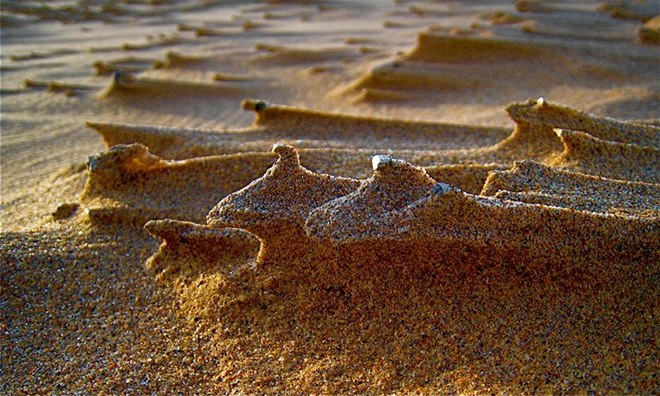
Here's a cool story about sand, courtesy of Wired. I love articles that explore the wonder behind everyday things. Next, I would love to see a story on the magic of dirt. Wait: the Exploratorium already produced a dirt site. Good for them!

[Image courtesy of Martyn Gorman]

Wednesday, January 6, 2010

Thales and Early Greek Science


I just found a fantastic website associated with the University of Virginia. It focuses on the origins of science in ancient Greece. I highly recommend perusing it.