Tuesday, March 20, 2012

Stunning Analog Science Art

Here's a beautiful video piece called "Compressed 03."  It was created by Kim Pimmel, who is intensely interested in the analog world.  I am actually very surprised that one can buy ferrofluid online.  Maybe I'll get some myself....


Compressed 03 from Kim Pimmel on Vimeo.

Tuesday, March 6, 2012

Supercomputer Simulation of Atmosphere

When I was a kid, I followed the T.V. weather forecasts all winter.  They were exciting because, on any given night, the forecaster might hint that a snowstorm was heading for my North Carolina hometown.  Of course, snow meant no school, as well as days of sledding, throwing snowing balls, and breathing in  crisp, cold air.  Since then, weather has fascinated me.

I am also interested in the beauty of computer simulations, so when I saw the video below, I thought I had to share it with my readers.  Watch it and enjoy!  Also, try to find the little red hurricanes swirling off America's east coast.  Very cool.

Sunday, March 4, 2012

Picturing Science

The tools scientists use to peer inside objects and take closer looks at tiny things have gotten extremely sophisticated.  A new show at the American Museum of Natural History called "Picturing Science" shows images from these amazing instruments.

[Image Courtesy of the American Museum of Natural History]

Friday, March 2, 2012

Meeting a Great Man

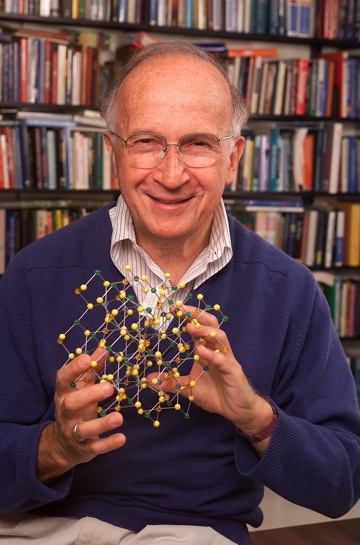
Every once in a while, you meet a truly great person.  Today was one of those days for me.  This afternoon, I spent two hours talking with chemist Roald Hoffmann, but Hoffmann is interesting not merely because he won a Nobel Prize in 1981.  He is also intensely interested in the intersection between art and science, as well as in aesthetics and ethics.  I've downloaded several of his essays, and find them all deep and fascinating.  Hoffmann is also in favor of clear writing in professional journal articles, though he told me that not all editors feel the same way, an opinion I find bizarre.  What is the point of writing anything if it's not as understandable as possible?  Don't professional chemists want to read clear writing?

Here's a great quote from the Nobel Prize website that shows Hoffmann's dedication to both language and science:

"The language of science is a language under stress.  Words are being made to describe things that seem indescribable in words -- equations, chemical structures and so forth.  Words do not, cannot mean all that they stand for, yet they are all we have to describe experience.  By being a natural language under tension, the language of science is inherently poetic.  There is metaphor aplenty in science.  Emotions emerge shaped as states of matter and more interestingly, matter acts out what goes on in the soul."

[Above Photo from Gary Hodges]

Thursday, March 1, 2012

When Art Captures the Microscopic World

Have you ever seen an art show featuring paintings of protozoa?  If not, stop by the Thorndike Gallery at Southern Oregon University to see an amazing show by artist Shoshana Dubiner, who has created a series of paintings that showcase the microscopic life all around us.  And, read more about the show here.

Monday, February 6, 2012


Science Ink: Tattoos of the Science ObsessedScience Ink: Tattoos of the Science Obsessed by Carl Zimmer
My rating: 5 of 5 stars


I loved this book!  I have no interest in getting a tattoo, but I love the idea of getting an image of a trilobite, or an equation, or Darwin's finches permanently marked on one's skin.  Some of the tattoos are technically amazing: one person had a tattoo of Francisco Goya's etching, _The Sleep of Reason Produces Monsters._  It looked amazing, and is one of the coolest tattoos I have ever seen.  Kudos to all involved!


View all my reviews

Sunday, January 8, 2012

Science and Blowing Glass


I was browsing the web tonight, looking for something cool to write about, and I was lucky to come across the "Science and the Arts" section of the Science Friday website.  I was especially drawn to an article about people who blow glass instruments for scientific use: think beakers, flasks, and various other thingamajigs used in labs.  I love the notion that scientists can work with these glass artists to create a custom piece, just right for that scientist's individual research, and I like the creativity involved.  Watch below to see footage of a scientific glass blower in action: