I am a science writer and independent museum consultant who is interested in the intersection of art and science. I am also fascinated by the history and philosophy of science. Check this blog for notes and updates about cool art-and-science miscellany.
I don't usually enjoy going to conferences, but recently I heard of an event that seemed like one of the coolest gatherings I had ever heard of. Beginning this Sunday at the Savannah College of Art and Design, and lasting through July 14th, is the Guild of Natural Science Illustrators annual conference. Presentations include "Science into Imagination: The Art of Creature Design," "Visual Storytelling for the World: Art Direction at National Geographic," and "Illustrating Misconceptions: How Scientific Graphics Can Mislead Students." My mind is officially blown. I love good science illustrations -- I once saw a live demonstration at the California Academy of Science, in San Francisco -- and the chance to go to an entire conference on the subject sounds beyond amazing. I may have to join this organization.
On Twitter, I follow the amazing Maria Popova, who also curates the very cool Brain Pickings website. I come back to this site day after day because of the eclectic content that touches on design, science, philosophy, and art, as well as the great design of the site itself. (That yellow and white together are wonderful.) This morning, Maria posted a Twitter link to the following animation featuring ferrofluids, a substance I first encountered at the Exploratorium, and then later at another exhibit in the New York Hall of Science. These liquids will blow your mind, as does this clip:
Jello has always seemed like it could be something besides food: it's too fun, and too weird, not to be. Now two people have found a way to use Jello to create music. Raphael Pluvinage and Marianne Cauvard have created a game consisting of a board that is in essence a capacitive sensor, and when a person places tiny, elegant blobs of the gelatinous fruity dessert on the board and touches it with his fingers, the board detects the finger pressure and movement, as well as the ingredients of the Jello, and translates that information into sound. Wow. I see the potential for dinner-time concerts in homes across the country.
There's something entrancing and magical about this bubble-blowing machine. I love the idea of building a device that creates something so evanescent. I still remember when I used to go to a summer day camp in North Carolina's SciWorks -- then called the "Nature Science Center" -- and all the campers used to dip string in bins of soapy water and blow through them. So peaceful and yet so exciting.
Here's a beautiful video piece called "Compressed 03." It was created by Kim Pimmel, who is intensely interested in the analog world. I am actually very surprised that one can buy ferrofluid online. Maybe I'll get some myself....
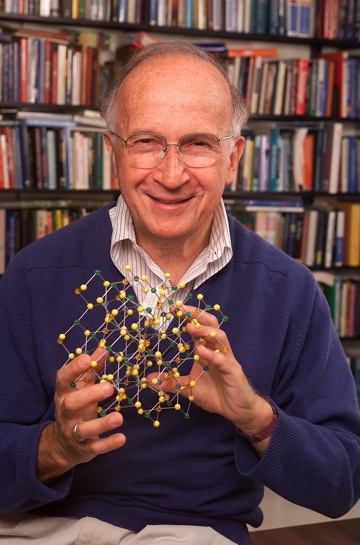
Every once in a while, you meet a truly great person. Today was one of those days for me. This afternoon, I spent two hours talking with chemist Roald Hoffmann, but Hoffmann is interesting not merely because he won a Nobel Prize in 1981. He is also intensely interested in the intersection between art and science, as well as in aesthetics and ethics. I've downloaded several of his essays, and find them all deep and fascinating. Hoffmann is also in favor of clear writing in professional journal articles, though he told me that not all editors feel the same way, an opinion I find bizarre. What is the point of writing anything if it's not as understandable as possible? Don't professional chemists want to read clear writing?
Here's a great quote from the Nobel Prize website that shows Hoffmann's dedication to both language and science:
"The language of science is a language under stress. Words are being made to describe things that seem indescribable in words -- equations, chemical structures and so forth. Words do not, cannot mean all that they stand for, yet they are all we have to describe experience. By being a natural language under tension, the language of science is inherently poetic. There is metaphor aplenty in science. Emotions emerge shaped as states of matter and more interestingly, matter acts out what goes on in the soul."
I was browsing the web tonight, looking for something cool to write about, and I was lucky to come across the "Science and the Arts" section of the Science Friday website. I was especially drawn to an article about people who blow glass instruments for scientific use: think beakers, flasks, and various other thingamajigs used in labs. I love the notion that scientists can work with these glass artists to create a custom piece, just right for that scientist's individual research, and I like the creativity involved. Watch below to see footage of a scientific glass blower in action:
When I was studying for my master's degree in science writing at the University of Southern California, I was fortunate to be able to take a class that focused on the history of science collections, and in particular cabinets of curiosity (the precursors to today's science museums). In that class, we learned about odd medical collections that included grotesque sculptures made out of preserved human innards, as well as more distinguished collections by people like Albertus Seba (whose cabinet made the pages of a Taschen book). I was already interested in the history of science museums, as well as miscellany, so the class fit me perfectly. Now, whenever I hear about modern cabinets of curiosity, my ears perk up.
So, I was excited to learn about the Nature Lab at the Rhode Island School of Design. What an amazing place! I love that the curators used old card catalogs, and I love that the collection includes three-dimensional geometric models for hands-on exploration. The Nature Lab is definitely on my short list of cool, wacky places to visit.
Did anyone else know that NASA had an art program? I sure didn't. And today, I learned that art from NASA's collection is being exhibited at the National Air and Space Museum in Washington, D.C. The artists featured in the show include Andy Warhol, Annie Leibovitz, and Norman Rockwell. Fascinating. You can learn more about the relationship between NASA and art here.
Image
Title: "Mission to Mars"
Oil on masonite painting by Ren Wicks. Wicks’ painting depicts Martian explorers conducting scientific observations, recording wind speed with an anemometer and planetary features with a hand-held camera. A dust storm is approaching the crater area near the landing site, but views of the moons Phobus and Deimos are available in the twilight sky. A Mars excursion vehicle in the background serves as crew quarters for the mission.